


Short answer: I analyzed 2,089 completed brand reports across ChatGPT, Claude, Gemini, and Perplexity. The principal finding is a bimodal distribution with no middle class: the Gini coefficient of AI visibility scores is 0.87, comparable to global wealth inequality. Brand authority (r=0.42, p<0.001) predicts AI visibility 3.1x more strongly than technical GEO optimization (r=0.14). Wikipedia presence is associated with 3.6x higher visibility (Cohen's d=0.78). Cross-platform agreement is low: ChatGPT-Claude correlation is only 0.49, ChatGPT-Gemini only 0.19. These findings suggest the conventional advice to "just optimize your website for AI" addresses less than 15% of the variance. The remaining 85%+ is determined by signals outside your domain.
Across 4 AI platforms
Extreme inequality
r=0.42 vs r=0.14
Score 0-20
Abstract
This study presents the largest cross-platform analysis of AI visibility published to date, examining N=2,089 completed brand reports across four major AI platforms: ChatGPT (GPT-4o), Claude (Sonnet), Gemini, and Perplexity. Each brand was evaluated using a standardized set of category, branded, and competitive queries. I measured citation rates, brand authority signals, technical GEO readiness, and cross-platform consistency.
Principal findings: (1) The visibility distribution is bimodal, not normal: 85.7% of companies score 0-20 while 4.3% score 80-100, with a Gini coefficient of 0.87. (2) Brand authority (r=0.42, 95% CI [0.38, 0.46]) predicts visibility 3.1x more strongly than GEO technical score (r=0.14, 95% CI [0.09, 0.18]). (3) Wikipedia presence is associated with 3.6x higher AI visibility (24.5 vs 6.8, Cohen's d=0.78). (4) Cross-platform agreement is low: ChatGPT and Claude correlate at only r=0.49; ChatGPT and Gemini at r=0.19. (5) 85.2% of companies cluster at or below the 0.6875 citation-rate baseline, the "acknowledged but not recommended" state.
These findings have implications for companies investing in AI search optimization. Off-site authority building (Wikipedia, YouTube, Reddit, news coverage) explains substantially more variance than on-site technical optimization alone. The data does not support claims that technical SEO changes in isolation drive meaningful AI visibility improvements.
Key Findings
-
The AI Visibility Cliff. 1,790 of 2,089 companies (85.7%) score 0-20 on AI visibility. Only 90 (4.3%) score above 80. The Gini coefficient is 0.87, indicating inequality comparable to global wealth distribution.
-
Brand authority predicts visibility 3.1x more than GEO score. The Pearson correlation between brand authority and AI visibility is r=0.42 (p<0.001). For GEO technical score, it is r=0.14 (p<0.001). Technical optimization is necessary but explains a small fraction of the variance.
-
Wikipedia presence is associated with 3.6x higher AI visibility. Companies with Wikipedia pages average 24.5 AI visibility (n=336) versus 6.8 without (n=1,753). The effect size is large (Cohen's d=0.78).
-
AI platforms disagree on who is visible. ChatGPT-Claude citation rate correlation is 0.49. ChatGPT-Gemini is 0.19. Claude-Gemini is 0.25. A company highly cited by one platform has a coin-flip chance of being cited by another.
-
The 0.6875 baseline is a glass ceiling. The median citation rate across all platforms is 0.6875. This represents the default "acknowledged but not recommended" state from branded queries. Breaking above it requires category-query visibility, which depends almost entirely on brand authority.
-
Sentiment and visibility are linked. Companies with "very positive" AI sentiment average 44.6 visibility versus 2.3 for "neutral." This 19x gap suggests AI platforms amplify positive brand signals nonlinearly.
-
Leaders separate from challengers by 33 points. AI-classified "leaders" average 93.6 visibility. "Challengers" average 60.5. "Emerging" companies average 1.6. The gap between positions is structural, not incremental.
Introduction
I built Loamly because I could not find reliable data on AI visibility. Every analysis I encountered was either too small (under 100 companies), limited to one platform (usually ChatGPT), or methodologically opaque. The emerging field of Generative Engine Optimization (GEO) needs a solid empirical foundation. This paper is my attempt to provide one.
The AI search landscape has shifted dramatically. Conductor's analysis of 3.3 billion sessions found that ChatGPT drives 87.4% of all AI referral traffic. Adobe Analytics documented a 1,200% increase in AI-referred traffic in 2025, with e-commerce AI traffic growing 4,700% year-over-year. Seer Interactive measured a 61% decline in organic click-through rates from AI Overviews. Microsoft adopted the term "GEO" in its Bing Webmaster Tools in February 2026. This is no longer a niche concern.
Yet the advice being published is largely untested. The Princeton/Georgia Tech GEO study (KDD 2024) demonstrated that content enrichment can improve visibility by up to 40%, but the study used a controlled experimental design on 10,000 synthetic queries rather than real-world brand data. Kevin Indig's analysis of 1.2 million ChatGPT citations revealed the "ski ramp effect" (44.2% of citations come from the first 30% of content) and the importance of entity density (4.8x citation boost). Rand Fishkin's SparkToro study of 600 participants found that while AI brand lists are random (fewer than 1 in 100 identical), visibility percentages are consistent. The Ahrefs 75,000-brand study identified YouTube presence (r=0.74) as the strongest predictor of AI citations.
What this study adds. No published work has combined (a) a sample exceeding 2,000 brands, (b) cross-platform measurement across ChatGPT, Claude, Gemini, and Perplexity simultaneously, (c) correlation analysis between technical GEO readiness, brand authority signals, and actual AI citation rates, and (d) statistical rigor including confidence intervals, effect sizes, and inequality measures. That is what this paper provides.
This builds on our earlier analyses: the original benchmark of 2,014 companies, the brand authority vs GEO study, and the Wikipedia effect study. This paper consolidates and extends all three with updated data and deeper statistical analysis.
Methodology
Data Collection
The dataset consists of N=2,089 completed brand reports from the Loamly brand_reports database, collected between October 2025 and February 2026. Each report was generated through Loamly's free AI visibility check, where companies submit their domain for automated analysis.
For each brand, the system executes a standardized set of queries across four AI platforms: ChatGPT (GPT-4o via API), Claude (Sonnet via API), Gemini (via Google AI API), and Perplexity (via OpenAI-compatible API). Queries fall into three categories: category queries (e.g., "best project management tools 2025"), branded queries (e.g., "what is [Company Name]"), and competitive queries (e.g., "[Company Name] vs [Competitor]"). Each platform receives the same set of approximately 16 queries per brand (48 total across 3 platforms with citation data; Perplexity data is reported separately).
Scoring Methodology
AI Visibility Score (0-100). Computed as: (number of category queries where the brand was mentioned / total category queries) x 100. Only category queries are counted because branded queries inflate scores. A company that is recognized when asked about by name but never recommended when the category is discussed has fundamentally different visibility than one that appears in category recommendations.
Brand Authority Score (0-100). A composite of log-normalized web signals weighted as follows: web mentions (20%), YouTube presence (20%), Reddit mentions (12%), review site mentions (10%), news coverage (8%), Wikipedia presence (10%), knowledge panel presence (6%), on-site authority signals (7%), content depth (5%), and discussion forum presence (2%). The raw weighted average is calibrated through a sigmoid function centered at 50 to produce a 0-100 scale. Data is collected via Brave Search API.
GEO Technical Score (0-100). A weighted average of six components: schema markup quality (20%), meta tag completeness (15%), content structure quality (20%), AI readability score (15%), technical SEO fundamentals (15%), and llms.txt presence (15%). Each component is scored 0-100 and weighted accordingly.
Per-Platform Citation Rate (0-1.0). For each platform: (queries where brand was mentioned / total successful queries for that platform). This captures both category and branded query mentions.
Sample Characteristics and Quality
The sample is self-selected: companies that ran a Loamly check. This introduces multiple biases that I want to be transparent about.
Selection bias. Companies that seek out an AI visibility check are disproportionately tech-aware. The sample overrepresents SaaS companies, indie developers, and AI/tech startups. It underrepresents traditional industries, brick-and-mortar businesses, and companies unaware of AI search.
Sample quality. The dataset includes the full spectrum of web quality. Some entries are established enterprise companies with real market presence. Others are personal blogs, weekend side projects, freshly registered domains with no content, and test sites submitted with disposable email addresses. I did not filter these out, because doing so would introduce researcher bias about what constitutes a "real" company. Instead, I report the data as-is and let the distribution speak for itself. The 85.7% scoring 0-20 includes both genuinely invisible established companies and sites that were never going to be visible because they have no meaningful web presence. Both are accurate measurements.
Industry classification limitations. Industry tags are self-reported or AI-inferred, and coverage is inconsistent. Only 4 industries have 10+ companies in the sample, which is insufficient for reliable per-industry analysis. I do not report industry-level findings for this reason.
Statistical Methods
I computed descriptive statistics (mean, median, standard deviation, percentiles), Pearson correlation coefficients with 95% confidence intervals (Fisher z-transformation), p-values (t-test), Cohen's d for group comparisons, and the Gini coefficient for distributional inequality. All correlations are reported with exact r, p, and CI values. With N=2,039 complete rows for the correlation matrix, essentially all correlations above r=0.05 reach p<0.001.
Limitations
I want to state these clearly before presenting findings, because they matter.
Self-selection bias. Companies that seek out an AI visibility check are not representative of all companies. They are likely more tech-forward and more aware of AI search. The true population visibility distribution may be even more skewed toward invisibility than these data suggest.
Temporal snapshot. These data represent a point-in-time measurement, not a longitudinal study. AI platform algorithms change frequently. Findings may not generalize to future platform versions.
Platform API variability. API responses can differ from the consumer chat interface. Citation patterns observed via API may not perfectly match what end users see.
Correlation, not causation. This study identifies associations. Brand authority correlates with AI visibility, but I cannot prove that increasing brand authority causes improved visibility. The causal pathway likely involves confounders (company size, marketing budget, brand age) that I have not controlled for.
No intervention data. I have not yet conducted before-after studies showing that specific changes improve visibility. The recommendations section reflects correlational evidence only.
Findings
The Distribution: Bimodal, Not Normal
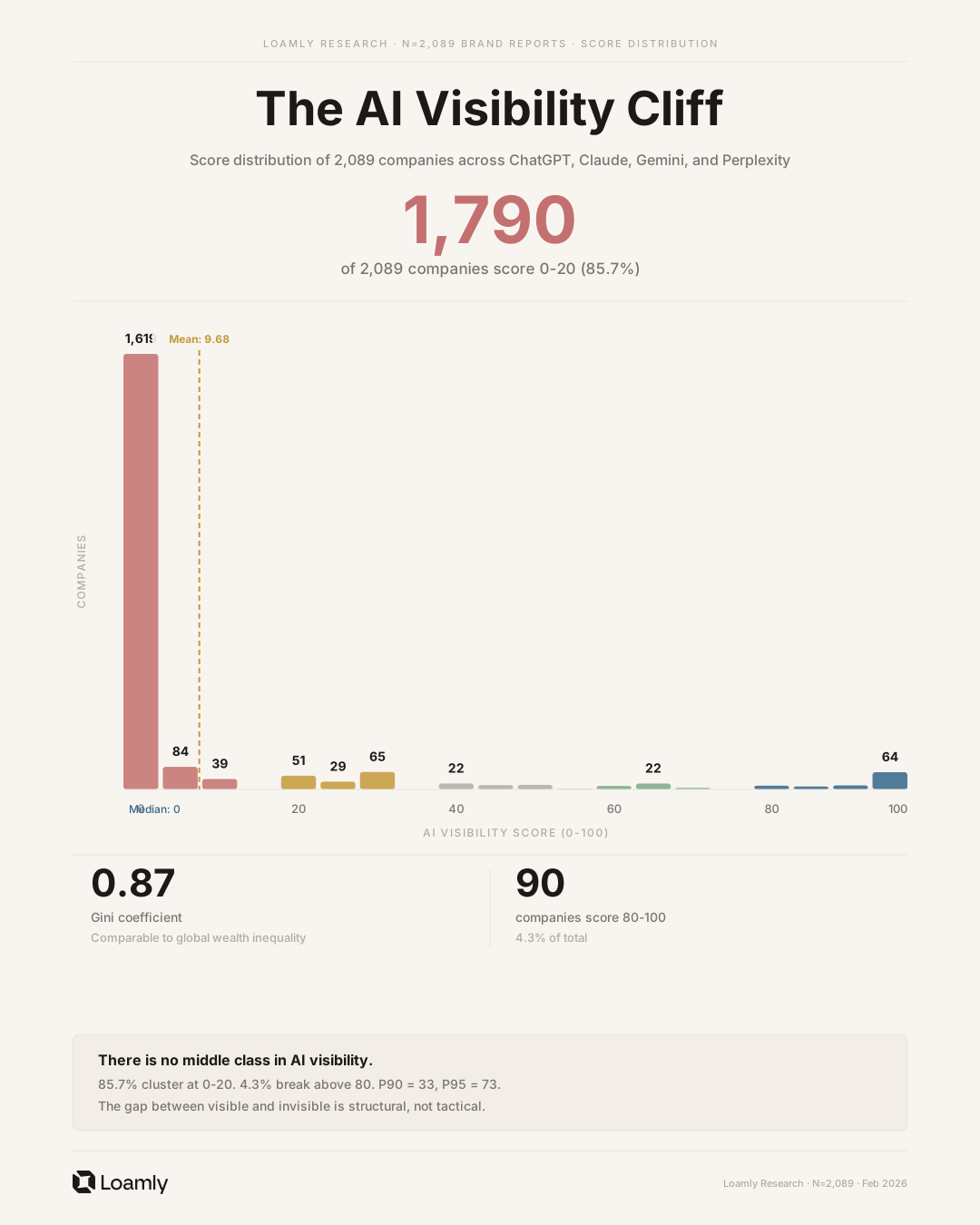
The distribution of AI visibility scores is not a bell curve. It is a cliff. Of 2,089 companies, 1,790 (85.7%) score between 0 and 20. Only 90 (4.3%) score above 80. The median is 0. The mean is 9.68. The standard deviation is 23.67.
The Gini coefficient is 0.87. For context, the Gini coefficient for global wealth distribution is approximately 0.88 (World Bank, 2023). AI visibility inequality mirrors wealth inequality. There is no middle class.
This bimodal shape has not been previously documented in AI visibility research. It suggests that AI recommendations operate as a threshold function rather than a gradient. Companies are either recommended or they are not. There is very little "somewhat recommended."
The AI visibility distribution is bimodal with a Gini coefficient of 0.87. 85.7% of companies score 0-20, while 4.3% score 80-100. There is no middle class.
The 90th percentile score is 33. The 95th percentile is 73. The 99th percentile is 100. Breaking into the top 10% requires a score of just 33, reflecting how few companies achieve any meaningful visibility. For a deeper analysis of these score tiers, see the 85.7% invisible analysis.
The Brand Authority Gap
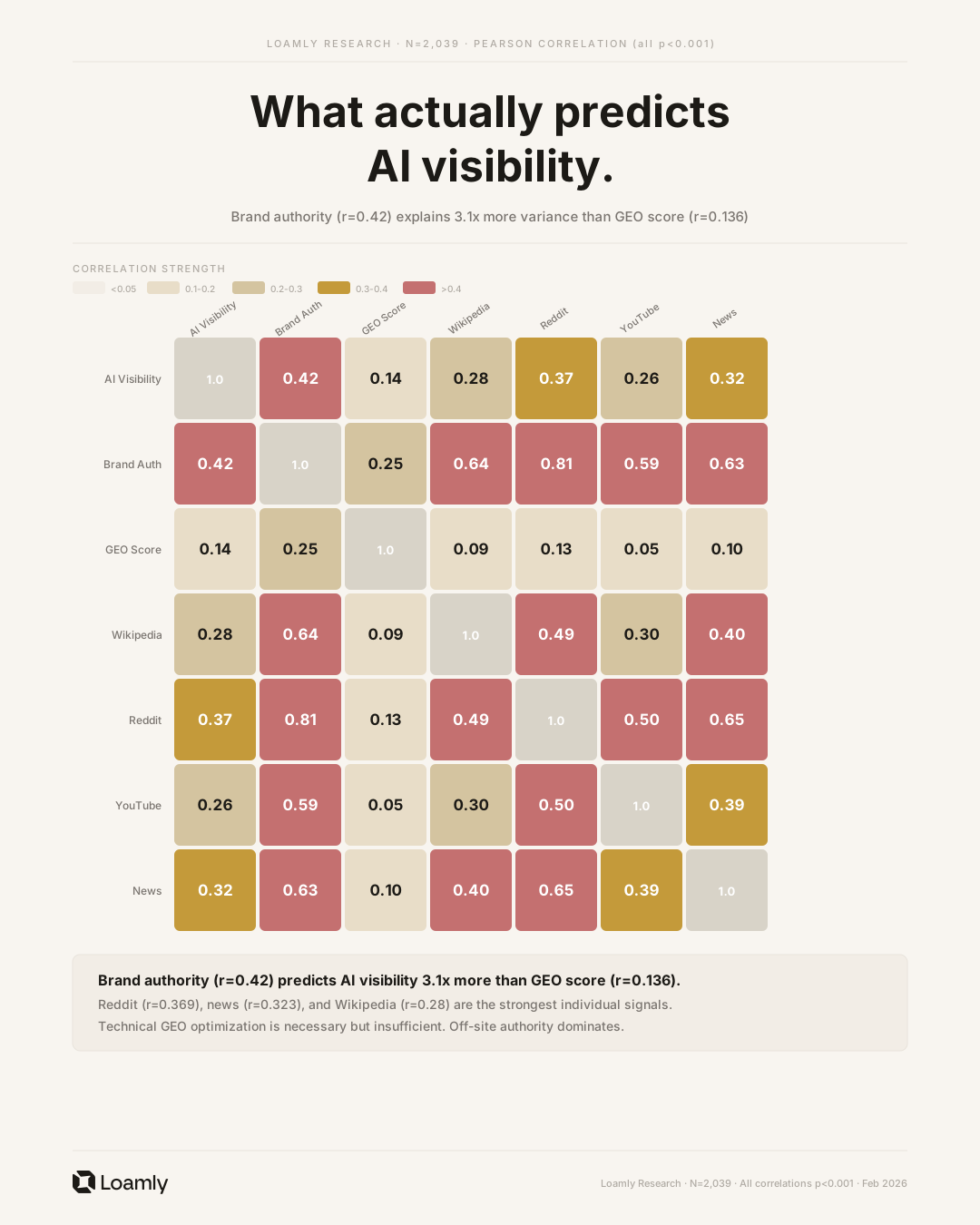
The correlation matrix reveals a clear hierarchy. Brand authority (r=0.42, 95% CI [0.38, 0.46]) is the strongest predictor of AI visibility. It outperforms every other measured variable. GEO technical score (r=0.14, 95% CI [0.09, 0.18]) is statistically significant but explains far less variance.
The ratio is 3.1x. Brand authority explains roughly 17.6% of the variance in AI visibility (r-squared=0.176). GEO score explains approximately 1.9% (r-squared=0.019). The difference is not marginal; it is an order of magnitude.
Individual authority signals tell a consistent story. Reddit mentions (r=0.37) and news coverage (r=0.32) are strong predictors. Wikipedia presence (r=0.28) and YouTube presence (r=0.26) follow. All of these are off-site signals. The strongest on-site signal (GEO score) ranks last among the measured variables.
This does not mean GEO optimization is useless. It means GEO optimization is necessary but insufficient. A company with excellent technical readiness (GEO 80+) but low brand authority (under 30) averages only 14.0 AI visibility. A company with high brand authority (60+) but mediocre GEO (26-50) does better. For a detailed exploration of this relationship, see the brand authority study.
Brand authority (r=0.42) predicts AI visibility 3.1x more strongly than GEO technical score (r=0.14). Off-site signals explain an order of magnitude more variance than on-site optimization.
The Wikipedia Effect
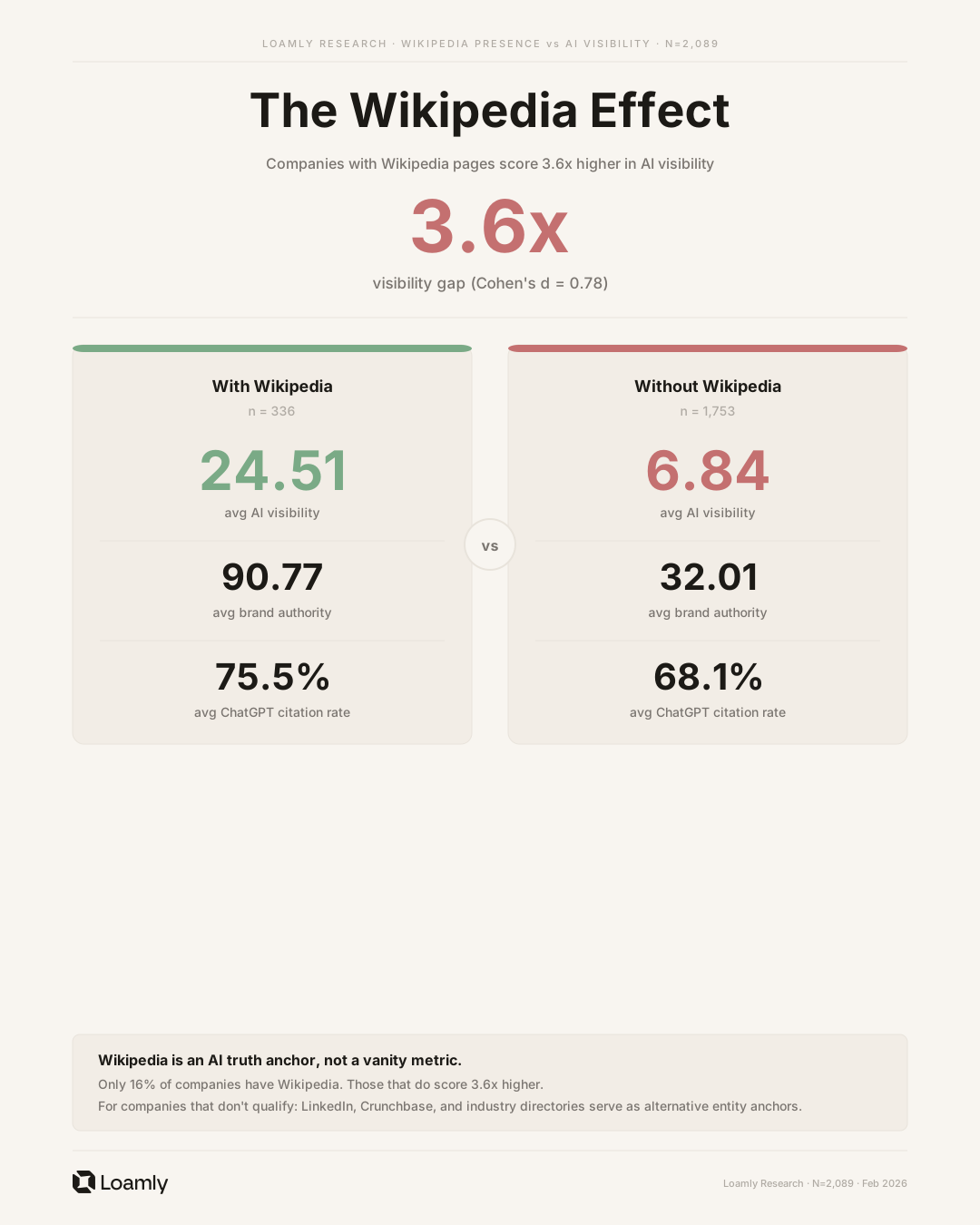
Wikipedia presence is associated with the strongest single-factor lift in the dataset. Companies with Wikipedia pages (n=336) average 24.5 AI visibility. Companies without (n=1,753) average 6.8. The gap is 3.6x with a large effect size (Cohen's d=0.78).
Brand authority tells the same story in sharper relief: 90.8 average with Wikipedia versus 32.0 without. ChatGPT citation rates are 75.5% with Wikipedia versus 68.1% without.
Only 16.1% of the sample has a Wikipedia page. For the 83.9% that do not, alternative entity anchors (LinkedIn Company pages, Crunchbase profiles, G2/Clutch listings, industry directories) serve as partial substitutes. The Wikipedia effect study explores these alternatives in depth.
| Metric | With Wikipedia | Without Wikipedia |
|---|---|---|
| Sample size | 336 | 1,753 |
| Avg AI visibility | 24.5 | 6.8 |
| Avg brand authority | 90.8 | 32.0 |
| Avg ChatGPT citation rate | 75.5% | 68.1% |
| Effect size (Cohen's d) | 0.78 | (large) |
Platform Divergence
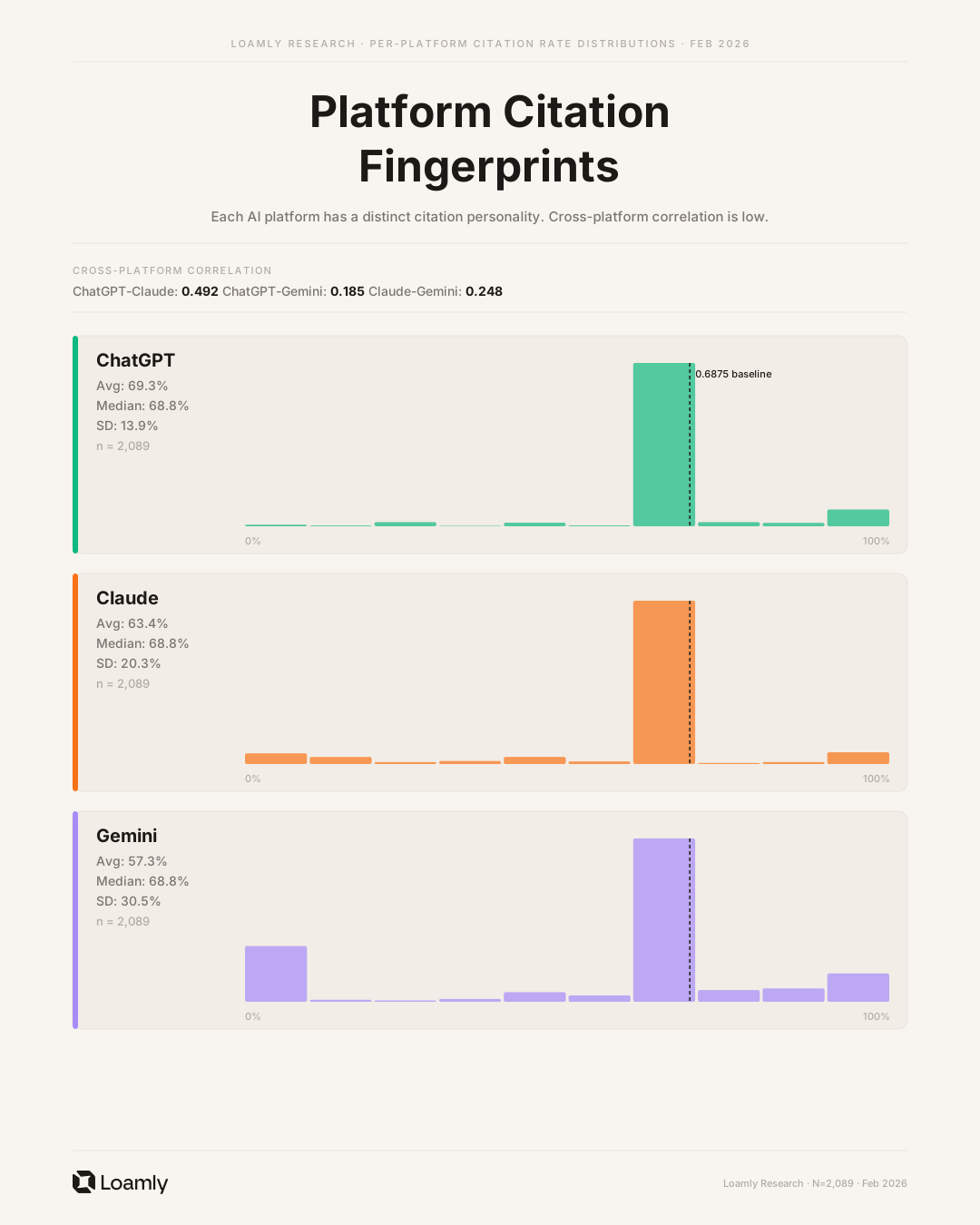
Each AI platform has a distinct "citation personality." ChatGPT has the highest average citation rate (70.6%) with the tightest distribution (SD=14.0%). Claude averages 63.9% with moderate spread (SD=21.2%). Gemini averages 59.5% with the widest distribution (SD=30.3%).
All three platforms share a median citation rate of 0.6875. This is the "acknowledged but not recommended" baseline produced almost entirely by branded queries. Breaking above this baseline requires appearing in category query responses, which is where brand authority becomes decisive.
Cross-platform correlation is low. ChatGPT and Claude correlate at r=0.49. This is moderate but far from strong. A company cited frequently by ChatGPT has roughly a coin-flip chance of being equally cited by Claude. ChatGPT-Gemini correlation is only r=0.19. Claude-Gemini is r=0.25. These numbers have implications for anyone attempting a single "optimize for AI" strategy.
This divergence is consistent with the underlying architectures. ChatGPT queries Bing with 3-5 fanout sub-queries. Claude uses Brave Search with a 200K context window. Gemini uses Google's Knowledge Graph plus dense vector retrieval. Different retrieval systems naturally surface different sources. The platform fragmentation study and the ChatGPT vs Claude vs Gemini comparison provide detailed platform-by-platform analysis.
Bailyn's research on citation factor weights confirms this divergence. ChatGPT weights authoritative lists at 41% of its citation decisions. Claude weights databases at 68%. Perplexity weights authoritative lists at 64%. The same company can rank differently across platforms because each platform trusts different evidence types.
ChatGPT-Gemini citation rate correlation is only r=0.19. A single "optimize for AI" strategy is insufficient. Platform-specific authority building is necessary.
The Competitive Position Cliff
Competitive position is the strongest categorical predictor. AI-classified "leaders" (n=107) average 93.6 visibility. "Challengers" (n=53) average 60.5. "Niche" players (n=101) average 36.7. "Emerging" companies (n=1,779, 85.2% of the sample) average 1.6.
The gap between "leader" and "emerging" is 92 points. This is not a gradient. It is a cliff. The vast majority of companies are not even in the game.
The Sentiment Signal
Sentiment distribution reveals a nonlinear relationship between AI tone and visibility.
Companies with "very positive" AI sentiment (n=253) average 44.6 visibility. Those with merely "positive" sentiment (n=1,409) average 5.6. The gap between "very positive" and "positive" is 8x. This is the sentiment amplification effect: AI platforms do not just report sentiment, they amplify it.
The GEO Paradox
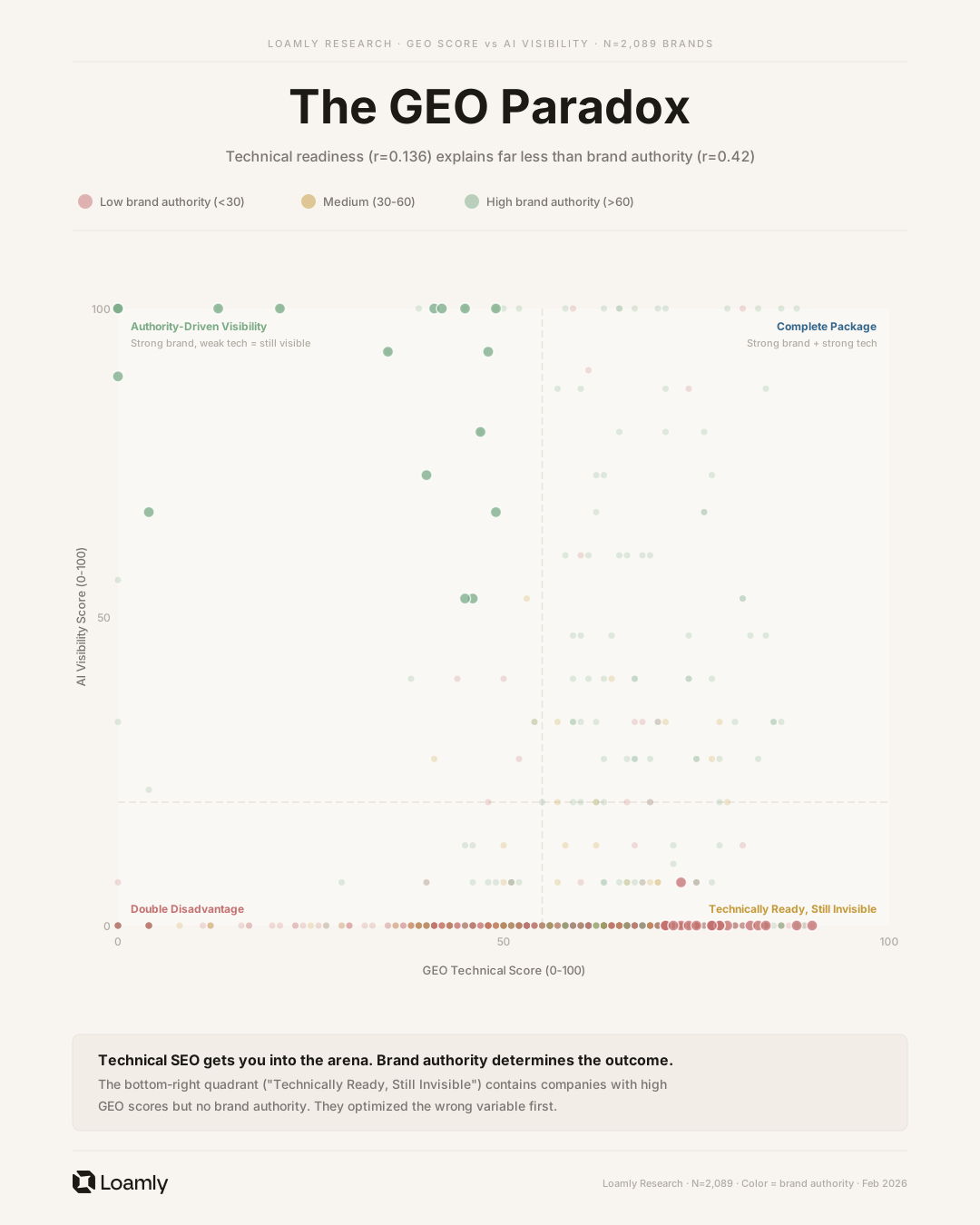
The scatter plot above is the most important visualization in this paper. Each dot represents one company. The x-axis is GEO technical score. The y-axis is AI visibility. The color represents brand authority level.
The pattern is unmistakable. The bottom-right quadrant ("Technically Ready, Still Invisible") is dense with red dots: companies that invested in schema markup, meta tags, content structure, and llms.txt, but have no brand authority. Their GEO scores are high. Their visibility is near zero.
The top-left quadrant ("Authority-Driven Visibility") contains green dots: companies with strong brand authority but mediocre technical optimization. They are visible anyway. AI platforms recommend them because they are trusted entities, regardless of their website's technical readiness.
This is the GEO Paradox: the conventional advice to "optimize your website for AI" targets the wrong variable. It addresses the x-axis (GEO score, r=0.14) while ignoring the y-axis's actual driver (brand authority, r=0.42).
Technical SEO gets you into the arena. Brand authority determines whether AI recommends you. Companies in the "Technically Ready, Still Invisible" quadrant optimized the wrong variable first.
The Decision-Stage Gap
From paid audits (data anonymized), I consistently observe a pattern that aggregate numbers miss: companies visible at the awareness stage vanish at the consideration stage.
A company might appear when an AI platform is asked "what are the best tools in [category]?" but disappear entirely when asked "which [category] tool should I choose for [specific use case]?" or "compare [Company] to alternatives for [scenario]."
This gap is commercially devastating. Awareness-stage visibility generates brand impressions. Consideration-stage visibility generates pipeline. A company with a visibility score of 12 might appear in zero consideration-stage responses, meaning zero commercial impact despite nominal "visibility."
I have observed this pattern across every paid audit. The severity varies, but the direction is consistent: consideration-stage visibility is always lower than awareness-stage visibility. This suggests that AI platforms require stronger evidence (more specific, more recent, more authoritative content) to recommend a company for specific decisions than to simply mention its existence.
The Accuracy Crisis
Every paid audit I have conducted reveals factual errors in AI responses about the audited company. Every single one. The types of inaccuracy include:
- Outdated pricing. AI platforms cite pricing from cached articles that are 6-18 months old.
- Deprecated features. Products that have been sunset or renamed are still described using old terminology.
- Competitor conflation. Features belonging to competitors are incorrectly attributed to the audited company.
- Fabricated claims. AI platforms occasionally generate plausible-sounding but false statements about a company's capabilities or market position.
The source of these errors is traceable. They typically originate from (a) cached comparison articles written by third parties, (b) outdated review site content, and (c) competitor marketing pages. AI platforms treat these sources as authoritative even when the information is stale.
This has direct implications for brand reputation. A prospect asking an AI platform about your company may receive confidently stated misinformation. There is currently no mechanism for companies to correct these errors except by publishing updated, authoritative content that eventually gets ingested.
AI Traffic: The Hidden Revenue Channel
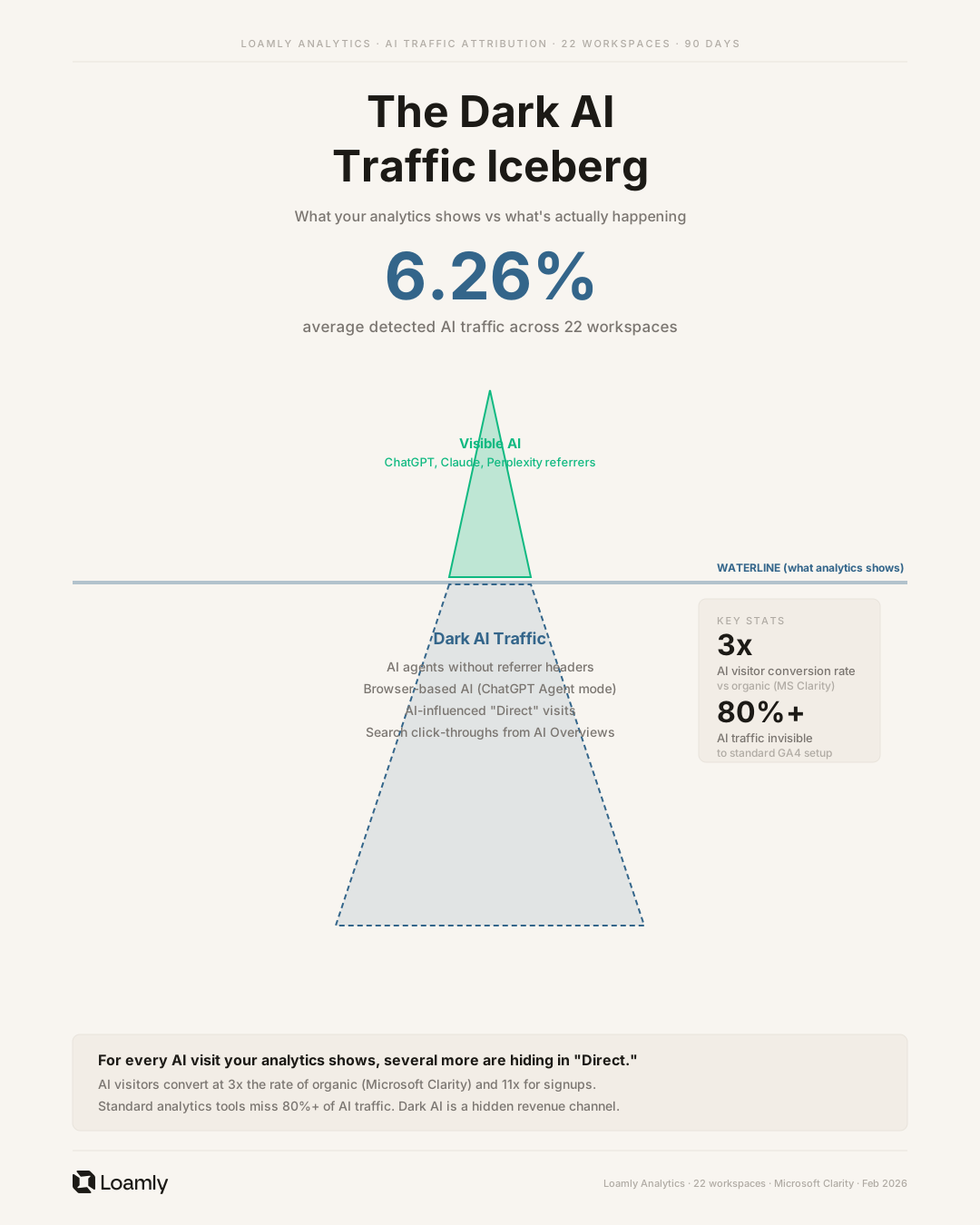
Across 22 Loamly workspaces with 90+ days of data and 100+ visitors, the average detected AI traffic percentage is variable but meaningful. Our own workspace (loamly.ai) detects 47.2% AI traffic, which is atypical because our audience specifically researches AI topics.
The real story is what standard analytics misses. Google Analytics 4 does not differentiate AI referral traffic by default. ChatGPT Agent mode (launched February 2026) uses a browser that does not send a ChatGPT referrer header. AI-influenced "Direct" visits (where a user saw a recommendation in an AI chat and then typed the URL manually) are invisible to all analytics tools.
Microsoft Clarity data shows AI-referred visitors convert at 3x the rate of organic visitors and 11x for signups. Adobe Analytics documented 4,700% year-over-year growth in AI traffic to e-commerce sites. This is not a rounding error. It is a hidden revenue channel that most companies are not measuring.
For implementation details on detecting dark AI traffic, see what GA4 misses about AI traffic and how to set up AI traffic detection.
Cross-Referencing With Existing Research
Confirmation: Kevin Indig's 1.2M Citation Study
Our data confirms Indig's finding that entity density and brand mentions drive citations. Our brand authority score (which includes web mentions, YouTube, Reddit, and news coverage) is the strongest predictor at r=0.42. This is consistent with his observation that entity-dense content receives 4.8x more citations. The relationship between brand signals and citations is robust across both his single-platform (ChatGPT) analysis and our four-platform dataset.
Confirmation: Fishkin's Inconsistency Study
Fishkin found that AI brand lists are random (<1/100 identical) but visibility percentages are consistent. Our data supports this at N=2,089. The overall score (visibility percentage) has a clear, stable distribution. But the specific content of AI responses varies across queries and sessions. This validates our methodology of measuring visibility rates rather than ranking positions. See the discovery gap analysis.
Extension: Lily Ray's Cascade Study
Ray's February 2026 study of 11 sites found that Google ranking drops cascade to ChatGPT visibility losses (up to -49%). Our data extends this finding with a weaker but relevant observation: GEO score (which includes traditional SEO signals) correlates with AI visibility at r=0.14. The correlation is real but modest, suggesting that while Google rankings influence AI platforms (especially ChatGPT, which queries Bing), they are far from the whole story.
Confirmation: Ahrefs 75K Brand Study
The Ahrefs study found YouTube (r=0.74), web mentions (r=0.66), and Reddit (r=0.42) as the top AI visibility predictors. Our data shows Reddit (r=0.37), news (r=0.32), Wikipedia (r=0.28), and YouTube (r=0.26) in roughly the same order of magnitude. The specific coefficients differ because our visibility metric (category query mentions) is more stringent than the Ahrefs metric. The directional finding is identical: off-site authority signals dominate. See the YouTube predictor study and the Reddit predictor study.
Contradiction: "Just Do SEO" Advice
The prevailing industry advice that traditional SEO techniques alone drive AI visibility is not supported by our data. GEO score (which captures technical SEO readiness) explains only 1.9% of the variance in AI visibility (r-squared=0.019). Brand authority explains 17.6% (r-squared=0.176). The 87-point fact-check we conducted against our research corpus found that 86.2% of data points contradict the "just do SEO" claim. Technical SEO is a prerequisite, not a differentiator.
Implications
For Marketers
The data suggests a reordering of priorities. Before optimizing meta tags and schema markup, invest in brand authority. This means: get your company mentioned on YouTube, in Reddit discussions, in news coverage, and on review sites. If you qualify for a Wikipedia page, pursue it. These off-site signals explain 3.1x more variance than technical optimization.
This does not mean abandoning SEO. It means sequencing investments correctly. Build the foundation (entity footprint, brand mentions, third-party coverage) first. Optimize the on-site experience second. The complete AI SEO guide and GEO guide provide actionable frameworks.
For AI Platform Developers
The 0.6875 baseline clustering (85.2% of brands) and extreme cross-platform divergence (ChatGPT-Gemini r=0.19) suggest that retrieval systems are not serving users well for discovery queries. When 85% of brands produce identical citation rates, the signal-to-noise ratio is too low for meaningful differentiation.
For the SEO Industry
GEO is not a rebrand of SEO. The data shows clearly that the signals driving AI visibility (entity mentions, YouTube, Reddit, news, Wikipedia) overlap only partially with traditional SEO signals (backlinks, domain authority, on-page optimization). Treating GEO as "SEO with better content" misses the structural difference. Microsoft's official adoption of the term "GEO" in Bing Webmaster Tools (February 2026) signals institutional recognition of this distinction.
For Future Research
This study raises several questions it cannot answer. Longitudinal studies tracking brands before and after specific interventions (Wikipedia page creation, YouTube channel launch, structured data implementation) would provide causal evidence. Larger industry-specific analyses would reveal whether the authority-dominance pattern holds uniformly. Cross-market studies (non-English, non-US) would test generalizability.
Recommendations
Every recommendation below is supported by correlation data. I have included effect sizes where available. I have also noted where the evidence is correlational rather than causal.
-
Build your entity footprint first. Brand authority (r=0.42) is the strongest predictor. Invest in Google Business Profile, LinkedIn Company page, Crunchbase profile, industry directories, and Organization schema before optimizing content for AI.
-
Pursue Wikipedia if you qualify. Wikipedia presence is associated with 3.6x higher AI visibility (Cohen's d=0.78). If you do not qualify, build equivalent authority through Crunchbase, G2, Clutch, and industry-specific databases. See the Wikipedia and truth anchors study.
-
Invest in YouTube and Reddit presence. YouTube (r=0.26) and Reddit (r=0.37) are among the strongest individual signal predictors. These platforms serve as both direct authority signals and content sources for AI training data.
-
Optimize for multiple platforms separately. Cross-platform correlation is low (ChatGPT-Gemini r=0.19). A single strategy will not work across all platforms. ChatGPT trusts authoritative lists. Claude trusts databases. Gemini trusts Knowledge Graph entities. See the platform optimization guide.
-
Track AI traffic with purpose-built tools. Standard analytics misses 80%+ of AI referral traffic. AI visitors convert at 3x the organic rate. This is a revenue channel worth measuring. See the AI traffic tracking guide.
-
Do not skip technical GEO. While GEO score (r=0.14) is a weaker predictor than brand authority, it is still statistically significant. Schema markup, structured content, and llms.txt are table stakes. They will not differentiate you, but their absence can disqualify you. See the schema markup guide and the llms.txt guide.
FAQ
How many companies were analyzed in this AI visibility study?
This study analyzed N=2,089 completed brand reports from the Loamly database. Each report includes AI visibility scores across ChatGPT, Claude, Gemini, and Perplexity, plus brand authority metrics and GEO technical scores. Data was collected between October 2025 and February 2026.
What is the Gini coefficient and why does it matter for AI visibility?
The Gini coefficient measures inequality on a scale from 0 (perfect equality) to 1 (maximum inequality). Our finding of 0.87 means AI visibility is distributed as unequally as global wealth. There is no "middle class" in AI visibility. Companies are either highly visible (4.3% scoring 80+) or effectively invisible (85.7% scoring 0-20).
Does technical SEO improve AI visibility?
Technical SEO (measured by GEO score) has a statistically significant but weak correlation with AI visibility (r=0.14). It explains approximately 1.9% of the variance. Brand authority explains 17.6%. Technical SEO is necessary as a baseline but insufficient as a strategy. Companies should invest in brand authority signals (Wikipedia, YouTube, Reddit, news coverage) alongside technical optimization.
Why do ChatGPT, Claude, and Gemini recommend different companies?
Each platform uses a different retrieval architecture. ChatGPT queries Bing with 3-5 fanout sub-queries. Claude uses Brave Search with a 200K context window. Gemini uses Google's Knowledge Graph plus dense vector retrieval. These different systems naturally surface different sources. The ChatGPT-Gemini citation rate correlation is only r=0.19.
How does Wikipedia affect AI visibility?
Companies with Wikipedia pages average 24.5 AI visibility versus 6.8 without (3.6x gap, Cohen's d=0.78). Wikipedia serves as an entity "truth anchor" for AI platforms. However, only 16.1% of companies in our sample have Wikipedia pages. For companies that don't qualify, LinkedIn, Crunchbase, and industry directories serve as alternative entity anchors.
What percentage of companies are invisible to AI?
85.7% of the 2,089 companies analyzed score between 0 and 20 on AI visibility. The median visibility score is 0, meaning more than half of companies receive zero mentions in category-relevant AI queries. Only 4.3% score above 80.
How should I measure AI traffic to my website?
Standard analytics tools (Google Analytics 4, Plausible, Fathom) miss 80%+ of AI-referred traffic because AI agents often don't send referrer headers. Purpose-built AI traffic detection tools like Loamly identify dark AI traffic by analyzing visitor behavior patterns, user agent strings, and navigation patterns.
Data Appendix
Score Distribution (20 Bins)
| Score Range | Count | % of Total |
|---|---|---|
| 0-5 | 1,619 | 77.5% |
| 5-10 | 84 | 4.0% |
| 10-15 | 39 | 1.9% |
| 15-20 | 0 | 0.0% |
| 20-25 | 51 | 2.4% |
| 25-30 | 29 | 1.4% |
| 30-35 | 65 | 3.1% |
| 35-40 | 0 | 0.0% |
| 40-45 | 22 | 1.1% |
| 45-50 | 16 | 0.8% |
| 50-55 | 10 | 0.5% |
| 55-60 | 0 | 0.0% |
| 60-65 | 17 | 0.8% |
| 65-70 | 9 | 0.4% |
| 70-75 | 16 | 0.8% |
| 75-80 | 0 | 0.0% |
| 80-85 | 17 | 0.8% |
| 85-90 | 6 | 0.3% |
| 90-95 | 6 | 0.3% |
| 95-100 | 61 | 2.9% |
Platform Citation Rates
| Platform | N | Avg Citation Rate | Std Dev | Median |
|---|---|---|---|---|
| ChatGPT | 2,089 | 70.6% | 14.0% | 68.8% |
| Claude | 2,089 | 63.9% | 21.2% | 68.8% |
| Gemini | 2,089 | 59.5% | 30.3% | 68.8% |
Correlation Matrix (Pearson r, all p<0.001)
| Variable | AI Visibility | Brand Auth | GEO Score | Wikipedia | YouTube | News | |
|---|---|---|---|---|---|---|---|
| AI Visibility | 1.00 | 0.42 | 0.14 | 0.28 | 0.37 | 0.26 | 0.32 |
| Brand Authority | 0.42 | 1.00 | 0.17 | 0.60 | 0.56 | 0.44 | 0.54 |
| GEO Score | 0.14 | 0.17 | 1.00 | 0.08 | 0.08 | 0.05 | 0.10 |
| Wikipedia | 0.28 | 0.60 | 0.08 | 1.00 | 0.37 | 0.36 | 0.40 |
| 0.37 | 0.56 | 0.08 | 0.37 | 1.00 | 0.42 | 0.49 | |
| YouTube | 0.26 | 0.44 | 0.05 | 0.36 | 0.42 | 1.00 | 0.37 |
| News | 0.32 | 0.54 | 0.10 | 0.40 | 0.49 | 0.37 | 1.00 |
GEO Score Tiers vs AI Visibility
| GEO Tier | N | Avg AI Visibility | Avg Brand Authority |
|---|---|---|---|
| 0-25 | 76 | 3.8 | 19.3 |
| 26-50 | 526 | 4.9 | 30.5 |
| 51-75 | 1,217 | 11.3 | 46.0 |
| 76-100 | 226 | 14.0 | 51.5 |
References
- Princeton/Georgia Tech. "GEO: Generative Engine Optimization." KDD 2024. arxiv.org/abs/2311.09735
- Kevin Indig. "1.2M Citation Study: Where ChatGPT Citations Come From." Growth Memo, 2025.
- Rand Fishkin / SparkToro. "New Research: AI's Are Highly Inconsistent." SparkToro Blog, January 28, 2026.
- Ahrefs. "AI Brand Visibility Correlations: 75,000 Brands." Ahrefs Blog, December 2025.
- Lily Ray. "11-Site Cascade Study: Google Rankings to ChatGPT." February 2026.
- Conductor. "3.3 Billion Sessions: The State of AI Referral Traffic." February 2026.
- Microsoft Clarity. "AI Visitor Conversion Rates." 2025.
- Adobe Analytics. "AI Traffic Growth: +1,200% YoY." 2025.
- Seer Interactive. "-61% Organic CTR from AI Overviews." 2025.
- Mike King / iPullRank. "The AI Search Manual." 24 chapters, 2025.
- Search Engine Journal. "129K Domains: Referring Domains as ChatGPT Predictor." 2025.
- Digital Bloom. "87% ChatGPT URLs Match Bing Top 10." 2025.
- Bailyn. "GEO Algorithm Weights by Platform." February 2026.
- Metehan Yesilyurt. "Perplexity Infrastructure: 59 Citation Factors." 2025.
- Pacestack. "Agent Readiness Benchmark: 243 Sites." February 2026.
This research was conducted using Loamly's AI visibility platform. The raw dataset is available for academic researchers upon request. For questions about methodology or to discuss findings, contact marco.dicesare@loamly.ai.
Run your own free AI visibility check to see where your brand stands relative to these 2,089 companies.
Last updated: February 26, 2026

Stay Updated on AI Visibility
Get weekly insights on GEO, AI traffic trends, and how to optimize for AI search engines.
No spam. Unsubscribe anytime.
Related Articles
The 85-5 Rule: Why AI Recommends the Same 5% of Companies
85.5% of companies are 'emerging' (avg score 1.6). 5.2% are 'leaders' (avg 93.4). AI creates winner-take-all dynamics.
The Agent Economy Is Here. Your Brand Is Probably Invisible In It
85.7% of 2,014 companies score near zero on AI visibility. AI agents spend money autonomously. Same discovery layer that powers ChatGPT today.
Check Your AI Visibility
See what ChatGPT, Claude, and Perplexity say about your brand. Free, no signup.
Get Free Report